Common ratio of a geometric sequence
First taught in Algebra 1
The common ratio of a geometric sequence is the fixed number that each number in the sequence, except the first number or starting number, is multiplied by. The figure below shows the common ratio for the geometric sequence 2, 6, 18, 54, ...
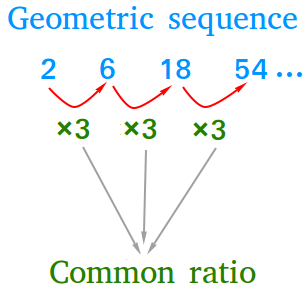
Notice that 6 / 2 = 3, 18 / 6 = 3, and 54 / 18 = 3. The name common ratio came from the fact that the ratio between consecutive numbers is constant.
Other examples showing what the common ratio of a geometric sequence is
a.
Geometric sequence: 5, 20, 80, 320, ...
The common ratio is 4
b.
Geometric sequence: 4, 20, 100, 500, ...
The common ratio is 5
c.
Geometric sequence: 4, 4r, 4r2, 4r3, ...
The common ratio is r
There is something interesting about c.!
The second number is 4r = 4r1
The third number is 4r2
The fourth number is 4r3
What can we conclude about the nth number?
Notice that the exponent shown in blue is always one less than the term number (shown in red). For example, for 4r3, the exponent is 3 for the 4th number.
We can also say that for 4rn -1, the exponent is n -1 for the nth.
Therefore, nth term = 4rn-1 for the geometric sequence 4, 4r, 4r2, 4r3, ...