Fraction
First taught in Grades 3–5 · also in Grades 6–8
A fraction is a number that can be written as , where a and b are whole numbers and b is not zero.
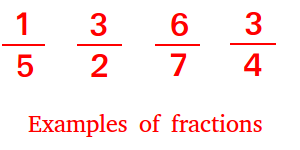
The top number, a, is the numerator. The bottom number, b, is the denominator. Here are some fractions:
Fractions as parts of a whole
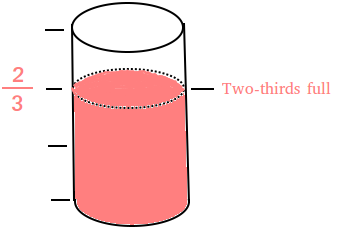
Fractions were first used to describe parts of a whole. The glass below is divided into 3 equal parts, and 2 of those parts contain liquid. So the glass is full: 2 out of 3 equal parts.
Fractions are more than parts of a whole
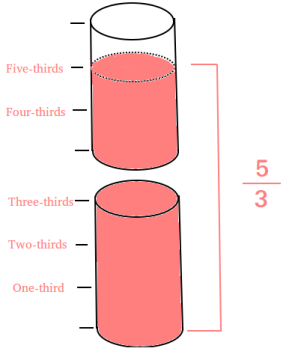
A common mistake is to think a fraction can only mean part of a whole. The definition allows any whole numbers for a and b, as long as b is not zero. For example, a can be 5 and b can be 3, which gives . That is more than one whole.
Why can't the denominator be 0? A fraction is also a division: means 4 ÷ 2. Dividing by zero has no answer, so something like is not a fraction.