Quadrant
First taught in Grades 6–8
Definition
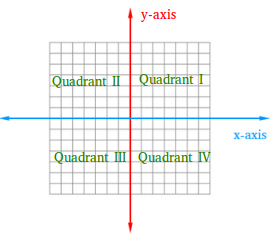
A quadrant is one of the four regions of the coordinate plane, separated by the -axis and the -axis.
Advertisement
The quadrants are numbered with Roman numerals I, II, III and IV, going counterclockwise starting from the upper right.
| Quadrant | Sign of | Sign of | Example point |
|---|---|---|---|
| I | |||
| II | |||
| III | |||
| IV |
Points on an axis are not in any quadrant. The point is on the -axis, and the origin is on both axes.
Example: In which quadrant is ? The -coordinate is negative and the -coordinate is positive, so it is in Quadrant II.
In trigonometry, the quadrant of an angle's terminal side tells you the signs of sine, cosine and tangent. A memory aid is "All Students Take Calculus": in Quadrant I all are positive, in II only sine, in III only tangent, and in IV only cosine.