Tetrahedron
First taught in Grades 6–8
Definition
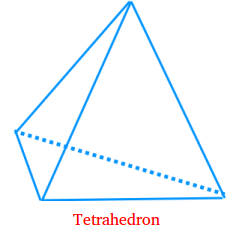
A tetrahedron, also called a triangular pyramid, is a solid with exactly four triangular faces.
Advertisement
A tetrahedron has:
- 4 faces, all triangles
- 6 edges
- 4 vertices
These numbers fit Euler's formula: .
Regular tetrahedron: if all four faces are equilateral triangles of the same size, the tetrahedron is regular. It is one of the five Platonic solids.
Any face can be the base, and the other three faces meet at a point called the apex.
Volume: like every pyramid,
For a regular tetrahedron with edge , this works out to . With cm, cm³.
Real-life examples: a four-sided die (d4), some tea bags and milk cartons, and the shape of a methane molecule.