Equally likely outcomes
First taught in Grades 6–8
Equally likely refers to two or more possible outcomes of a given situation that have the same probability or the same likelihood to occur.
For example, if you throw a die, there are six possible outcomes. You could get 1, 2, 3, 4, 5, or 6. These outcomes are equally likely to occur.
In other words, the probability to get a 1 is the same as the probability to get a 2,3,4,5,or 6.
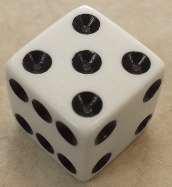
A weighted die is a die that has been modified so some outcomes are more likely to occur than others.
Note that if you use a weighted die, then the outcomes will not be equally likely.
More examples of equally likely outcomes
- When you flip a coin, the two outcomes ( heads or tails ) are equally likely to occur.
- Suppose you have 20 songs on Windows Media Player and you set it to play the songs randomly. The outcomes of listening to all 20 songs are equally likely.
- Suppose you put 5 yellow balls, 2 red balls, and 3 blue balls in a bag and trying to pick 1 ball. Each of the 10 balls is equally likely to be picked. However, the colors are not equally likely: yellow (5 out of 10) is more likely than red (2 out of 10).
Notice the difference: when you pick a ball without looking, each single ball has the same chance of being picked, but a color with more balls has a better chance.