Intersecting lines
First taught in Grades 3–5
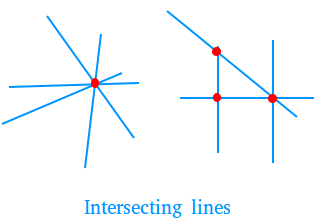
Intersecting lines are two or more lines that cross or meet at a point. That point is called the point of intersection.
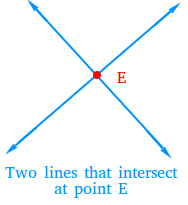
In the figure, the two lines meet at point E, their point of intersection.
Two different lines can intersect at most once. Because lines are straight, once they cross they move apart forever.
Angles at an intersection: two intersecting lines form four angles.
- Opposite angles are vertical angles, and they are equal.
- Neighboring angles are adjacent angles that add up to .
Example: If one of the four angles is , the others are , and .
Special case: lines that intersect at a right angle are perpendicular.
Lines that do not intersect: in a plane, parallel lines never meet. In space, skew lines never meet either, even though they are not parallel.
On a graph: the intersection of and is where , so and : the point . Finding where lines intersect is how you solve a system of equations by graphing.