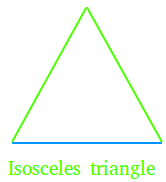
Isosceles triangle
First taught in Grades 3–5
Definition
An isosceles triangle is a triangle that has at least two sides of equal length.
Advertisement
The word comes from the Greek isos, meaning "equal", and skelos, meaning "leg". In the figure, the equal sides (the legs) are green and the third side, the base, is blue.
Properties:
- The two angles opposite the equal sides, called the base angles, are equal.
- The angle between the two legs is the vertex angle.
- The line from the vertex angle to the middle of the base is a line of symmetry. It cuts the base in half at a right angle.
Example: The vertex angle of an isosceles triangle is . Each base angle is
Example: A base angle is . The other base angle is also , so the vertex angle is .
An equilateral triangle, with all three sides equal, is a special isosceles triangle. A triangle with no equal sides is a scalene triangle.