Mass of an object
First taught in Grades 3–5
There are two ways to define the mass of an object as shown below:
- Mass is the quantity or amount of matter inside an object
- Mass is the measure of an object's inertia
Mass as the amount of matter inside an object
The amount of matter or material inside an object depends on the number of atoms and the kind of atoms that compose the object.
Something can be small and yet it may have a lot of matter inside of it. For example, a gold bar could have a mass of 2 kg
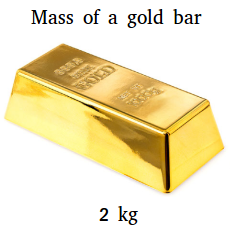
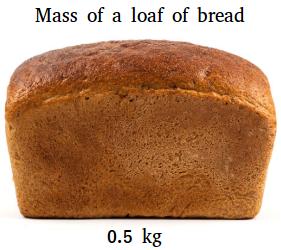
A loaf of bread could be about the same size or even bigger than the gold bar. However, the loaf of bread can be less massive than the gold bar.
Mass as the measure of an object's inertia
Mass is also a measure of the inertia or " laziness" that an object exhibits when you try to move it or stop it from moving.
The higher the mass, the harder it will be to move or stop the object. It is easier to push a dog than it is to push an elephant!
The elephant has more inertia or more "laziness" than the dog. We are not saying that the elephant is lazy. What we mean by more "laziness" is that it will be harder to move the elephant.
Is the scale showing weight or mass?
A bathroom scale actually measures how hard you push down (your weight), then shows the result as a mass in kilograms or pounds.

Observations about the mass of an object
- The mass is always the same regardless of the location. Your mass is the same on the earth as on the moon.
- The mass of the earth is 5.9722×1024 kg.
- The mass of an electron is 9.1093837 × 10⁻³¹ kg.