Percent of change
First taught in Grades 6–8
The percent of change tells how much a quantity has increased or decreased, as a percent of its original value: .
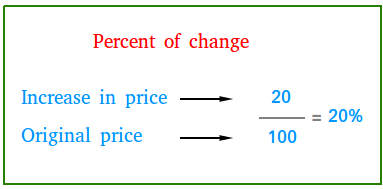
20% is an example of percent of change.
Generally speaking, the percent of change is the ratio of the amount of change to the original amount.
When a value increases from its original amount, it is called the percent of increase.
When a value decreases from its original amount, it is called the percent of decrease.
A couple of examples showing how to find the percent of change
Example #1
The price of a T-shirt decreased from $25 to $21. Find the percent of change, called in this case the percent of decrease.
Percent of decrease = amount of change / original amount
The amount of change is 25 - 21 = 4 and the original amount is 25.
Percent of decrease = 4 / 25 = 16 / 100 = 16%
Example #2
In 1997, 1 share in Amazon was worth about $18. By the end of 2020, 1 share in Amazon was worth about $3,200. Find the percent of change, called in this case the percent of increase.
Percent of increase = amount of change / original amount
The amount of change is 3200 - 18 = 3182 and the original amount is 18.
Percent of increase = 3182 / 18 = 176.77 ≈ 177
177 / 1 = 17700 / 100 = 17700%
The price of 1 share in Amazon increased by about 17700%