Unit cube
First taught in Grades K–2
A unit cube is a cube whose edges are each 1 unit long, so its volume is 1 cubic unit.
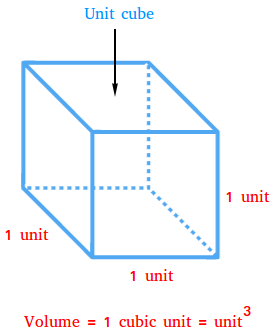
Every face of a unit cube is a square with sides of 1 unit, so each face has an area of 1 square unit. All 6 faces together have a surface area of 6 square units.
Unit cubes measure volume. The volume of a solid is the number of unit cubes that fill it with no gaps or overlaps.
Example: A box that holds 5 rows of 4 unit cubes, stacked 3 layers high, has a volume of
That is the same as the formula for a rectangular prism.
Unit cubes with real units:
- 1 cubic centimeter (cm³): about the size of a sugar cube.
- 1 cubic inch (in³): about the size of a die.
- 1 cubic foot (ft³).
In the classroom: base-ten blocks use small unit cubes for ones, rods of 10 cubes for tens, flats of 100 for hundreds, and a big cube of 1,000.
See also cubic unit and volume of a space figure.