Composite number
First taught in Grades 3–5
Definition
A composite number is a counting number or whole number with more than 2 factors.
Advertisement
For example, 4 has 3 factors and these factors are 1, 2, and 4.
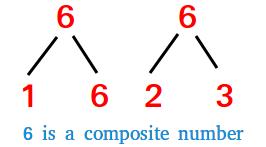
6 has 4 factors and these factors are 1, 2, 3, and 6.
9 has 3 factors and these factors are 1, 3, and 9.
Therefore, 4, 6, and 9 are composite numbers since they each have more than 2 factors.
A composite number is also called composite.
Any composite number can be written as the product of two smaller whole numbers that are both greater than 1. For example, 6 = 2 × 3 and 9 = 3 × 3.
A prime number, like 7, cannot be written this way. Its only factorization is 1 × 7.