Multiple
First taught in Grades 3–5
Definition
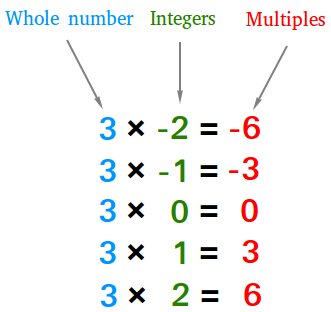
A multiple of a whole number is the product of that number and an integer.
Advertisement
For example, 35 is a multiple of 5 because the product of 5 and 7 is 35. By the same token, -35 is also a multiple of 5 because the product of 5 and -7 is -35.
Some multiples of 5 are shown below in red.
5 × 0 = 0
5 × 1 = 5
5 × 2 = 10
5 × 3 = 15
5 × 4 = 20
5 × 5 = 25
5 × 6 = 30
5 × 7 = 35
5 × 8 = 40
5 × 9 = 45
Notice that zero is also a multiple of 5. In fact, zero is a multiple of every number since zero × any number is equal to 0.
More examples of multiples
Some multiples of 3 are: -18, -15, -12, -9, -6, -3, 0, 3, 6, 9, 12, 15, and 18
Some multiples of 7 are: -42, -35, -28, -21, -14, -7, 0, 7, 14, 21, 28, 35, and 42