Protractor
First taught in Grades 3–5
A protractor is a tool used to measure and draw angles in degrees.
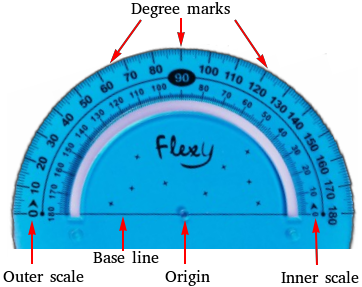
What are the parts of a protractor?
A protractor has 5 main parts.
- Origin
- Inner scale
- Outer scale
- Base line
- Degree marks
Measuring angles with a protractor
You can use a protractor to measure angles clockwise or counterclockwise from 0 degree to 180 degrees. To measure an angle, follow the steps below:
Step 1:
Put the vertex of the angle you want to measure at the origin of the protractor.
Step 2:
Align one arm of the angle with the base line of the protractor. The other arm of the angle will point to the measure of the angle.
Step 3:
Use the inner scale of the protractor if you are measuring counterclockwise. Use the outer scale of the protractor if you are measuring clockwise. The number you see on the degree marks is the measure of the angle.
Examples showing how to measure angles with a protractor
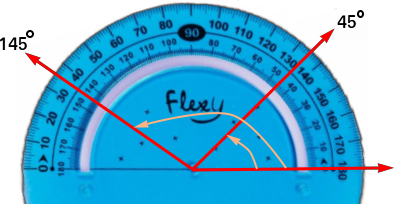
The two angles below are measured counterclockwise by using the inner scale or the "scale at the bottom." The acute angle or smaller angle is equal to 45 degrees and the obtuse angle or bigger angle is equal to 145 degrees.
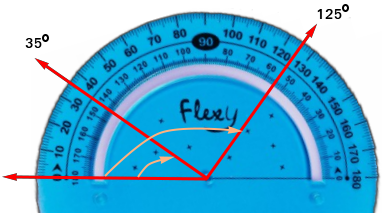
The two angles below are measured clockwise by using the outer scale or the "scale on top." The acute angle or smaller angle is equal to 35 degrees and the obtuse angle or bigger angle is equal to 125 degrees.
Types of protractors
The two different types of protractors that teachers mostly use in school are the semi-circle protractor and the full-circle or circular protractor. The semi-circle protractor is the one you see in the figure above.
The full-circle protractor is shown below and the scale goes from 0 degree to 360 degrees.