Kite
First taught in Grades 3–5
Definition
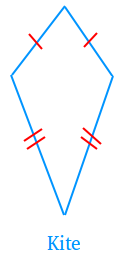
A kite is a quadrilateral with two pairs of equal adjacent sides: two equal sides next to each other, and another two equal sides next to each other.
Advertisement
In the figure, tick marks show which sides are equal.
Properties of a kite:
- Two pairs of adjacent sides are equal, but opposite sides are not (unless it is a rhombus).
- The diagonals are perpendicular.
- One diagonal (the main one, between the vertices where equal sides meet) cuts the other in half.
- One pair of opposite angles, the ones between unequal sides, are equal.
- It has one line of symmetry, along the main diagonal.
Area: half the product of the diagonals.
Example: a kite has diagonals of 10 cm and 6 cm. Its area is cm².
A kite is not a parallelogram: in a kite, opposite sides are generally not parallel.
Special case: if all four sides are equal, the kite is a rhombus.
Real-life examples: a toy kite, some road signs and diamond-shaped patterns.