Trapezoid
First taught in Grades K–2
A trapezoid is a quadrilateral with exactly one pair of parallel sides.
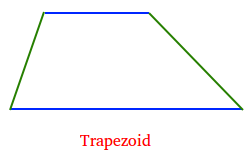
In the figure, the parallel sides, called the bases, are blue. The other two sides are the legs.
Why "exactly one pair"? If a quadrilateral has two pairs of parallel sides, it is a parallelogram instead. (Some books use "at least one pair", which makes parallelograms special trapezoids. US school standards differ, so check your textbook.)
Area: average the two bases and multiply by the height.
Example: A trapezoid has bases 9 cm and 5 cm and a height of 4 cm.
Facts:
- The angles along each leg add up to .
- The midsegment joins the midpoints of the legs. It is parallel to the bases and its length is the average of the bases.
Types: an isosceles trapezoid has equal legs. A right trapezoid has two right angles.
Real-life examples: the shape of a bucket from the side, a popcorn box, and many handbags. In British English, this shape is called a trapezium.