Parallelogram
First taught in Grades 3–5
Definition
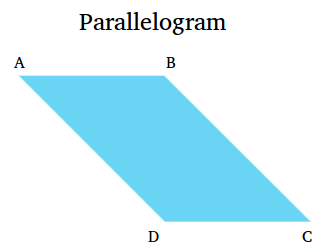
A parallelogram is a quadrilateral with both pairs of opposite sides parallel.
Advertisement
In the figure, quadrilateral is a parallelogram because and .
Properties of every parallelogram:
- Opposite sides are equal in length.
- Opposite angles are equal.
- Neighboring angles add up to .
- The diagonals cut each other in half.
Example: One angle of a parallelogram is . The opposite angle is also , and the other two are each .
Area:
where is the base and is the height, measured straight up from the base (not the slanted side). A parallelogram with base 8 cm and height 5 cm has area 40 cm².
Special parallelograms:
- Rectangle: four right angles.
- Rhombus: four equal sides.
- Square: both, four right angles and four equal sides.
A trapezoid has only one pair of parallel sides, so it is not a parallelogram.